Soil Nailing vs. Traditional Shoring: Which Solution Is Right for Your Project?
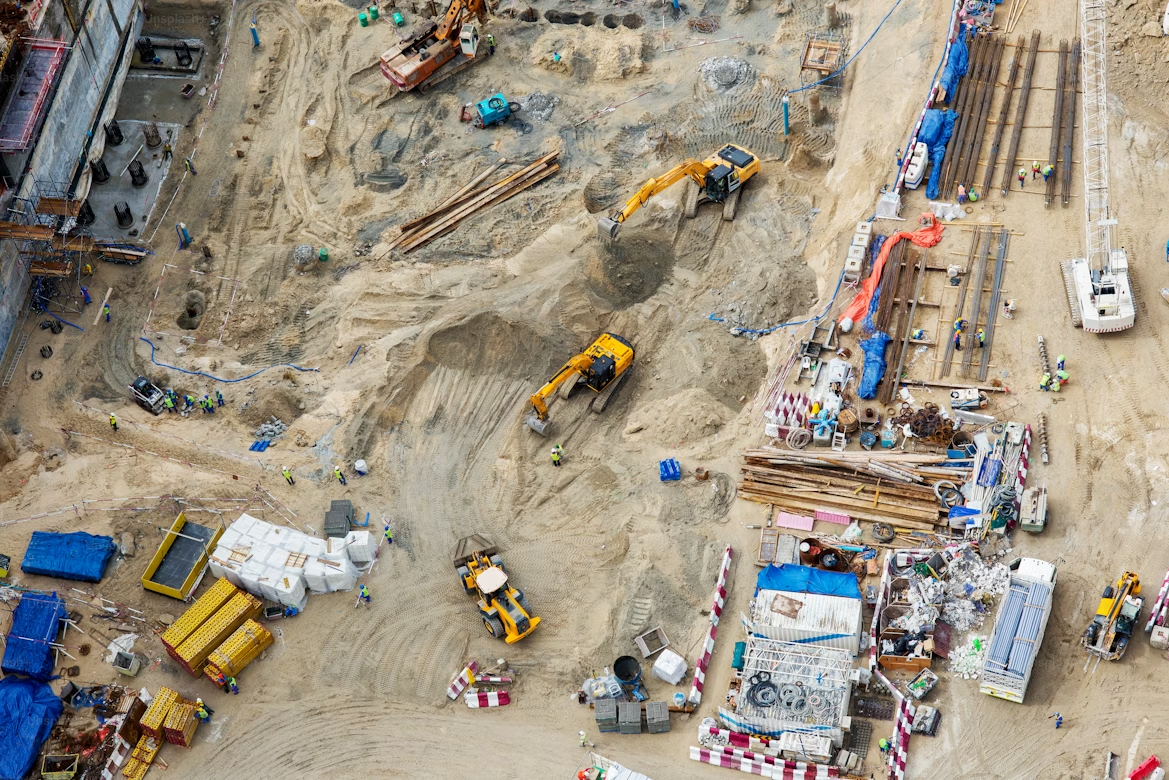
When it comes to excavation support and slope stabilisation, two of the most widely used methods are soil nailing and traditional shoring systems such as soldier pile walls, sheet piling, and secant pile walls. Both are effective, but they serve different purposes and perform best in different conditions. Understanding the key differences will help you and your engineer choose the right solution for your specific project.
What Is Soil Nailing?
Soil nailing is an in-situ reinforcement technique used to stabilise existing ground — typically natural slopes, embankments, or excavation faces. The process involves drilling holes into the soil at regular spacing, inserting steel reinforcement bars (the "nails"), and grouting them in place. A structural shotcrete facing is then applied to the excavation surface for additional stability and protection.
The nails work by transferring tensile forces between the unstable soil mass and the stable ground behind it, effectively preventing movement. As excavation proceeds downward, new rows of nails are installed progressively — the work follows the excavation rather than preceding it.
What Is Traditional Shoring?
Traditional shoring (or earth retention systems) refers to a broad category of methods that create a structural wall to hold back earth and maintain the sides of an excavation. Common types include:
- Soldier pile and lagging walls — steel H-piles driven at intervals with timber or concrete lagging between them
- Sheet pile walls — interlocking steel sheet sections driven into the ground
- Secant or contiguous pile walls — rows of overlapping or closely spaced bored piles forming a continuous wall
- Diaphragm walls — reinforced concrete walls cast in situ in a trench
Unlike soil nailing, shoring systems are typically installed before excavation begins. They create a retaining wall that allows safe digging on the other side.
Key Differences
Installation Sequence
Shoring walls are installed before excavation, whereas soil nails are installed during excavation, following the dig down in stages. This makes soil nailing a top-down process and shoring a pre-construction process.
Suitability by Soil Type
Soil nailing works best in cohesive or semi-cohesive soils (dense sands, gravels, stiff clays) that can stand unsupported for a short period while the nail and shotcrete are applied. It is less suitable for loose granular soils, saturated conditions, or very soft clays. Traditional shoring systems are generally more versatile and can be used across a wider range of soil conditions, including very weak or waterlogged ground.
Cost
For suitable soil conditions, soil nailing is typically more cost-effective than traditional shoring. It requires less material and equipment, and the installation proceeds concurrently with excavation. However, if soil conditions require extensive drainage or if the nailing requires very long bars, the economics can shift. Traditional shoring has higher upfront costs but may be more predictable on complex urban sites.
Space Requirements
Soil nailing requires space behind the excavation face for the nails to be drilled and for the reinforced soil mass to develop — typically at least 5–8 metres of unencumbered ground behind the face. This makes it unsuitable for excavations immediately adjacent to buildings or roads. Traditional shoring systems can be built at the property boundary, making them the standard choice in dense urban environments.
Permanent vs. Temporary
Both methods can be designed for permanent or temporary use, but traditional shoring is more commonly used as a permanent retention system (particularly secant pile and diaphragm walls, which become the basement walls of a building). Soil nailing is more often used for temporary support or slope stabilisation.
Which Should You Choose?
The right choice depends on several factors that our engineers assess during the design stage:
- Soil and groundwater conditions — determined by geotechnical investigation
- Proximity to adjacent structures — closer buildings typically require shoring
- Excavation depth — deeper excavations may require more robust shoring systems
- Available land behind the excavation face — soil nailing needs space
- Budget and programme — soil nailing is often faster and cheaper in suitable conditions
- Permanent or temporary requirement — permanent walls usually favour shoring
"There is no single best solution — the right answer always comes from a thorough understanding of the ground conditions and the project constraints. Our job is to match the method to the challenge."
At Roots for Foundations, we offer both soil nailing and all major traditional shoring solutions. Our geotechnical engineers will assess your site conditions and recommend the most appropriate, cost-effective approach. Contact us to discuss your project.